

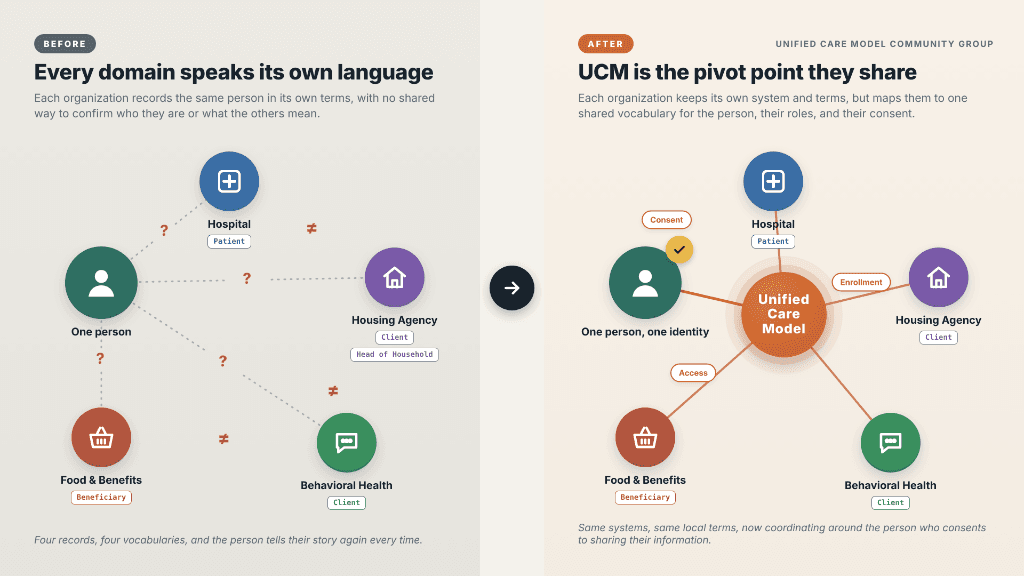
Imagine being treated as a different person by every organization that helps you. The hospital knows you as a patient. The housing agency knows you as a client. The food pantry has you down as a recipient. A benefits office still has you under your maiden name. You're the same person the whole time, but every time you move between them, you tell your story again from the start. This is the status quo, and it prevents people from getting help.
This is not really a technology problem — it's a thinking problem. Each organization built its own idea of who you are, shaped by what they do for you, and none of them ever had to agree on who you are to all of them at once.
That's why I'm working on the W3C's new Unified Care Model Community Group (aka "UCM"): an international, open source way for hospitals, housing agencies, behavioral health providers and other social service organizations to agree on one simple thing — you're the same person no matter which door you walk through. It's also known as Whole Person Care. It doesn't replace any of the systems these organizations already use; it's a framework that lets them talk about the same person without giving up what makes their own systems work.
In practice, that means: a person stays one stable identity, even as the role they're playing changes with context — patient here, client there, caregiver somewhere else. Two organizations that each have their own record for the same person can confirm it's really one person, instead of creating a confusing duplicate. And when a care team forms across organizations, people join it deliberately, by invitation and agreement, with real limits on what gets shared and with whom.
Confidentiality isn't an afterthought in any of this. Information doesn't move as one big shared file — each piece carries its own client-controlled rules about who can see it and what it's for. A behavioral health counselor can join someone's care team and share a short summary the team needs, while keeping therapy notes inside their own walls. A food pantry can learn someone's dietary needs without needing to access their medical history. And people have a real say in who joins their care team and what gets shared with them in the first place — it isn't assumed on their behalf.
This isn't abstract tech policy. It's how we stop people from falling through cracks that exist only because our systems each talk in their own terms. But when they share a common language for things like household membership, goals and purpose, or triage steps — something each care team domain can separately relate back to — UCM becomes the pivot point of collaboration. We're still early, and there's real room to help shape this. Anyone can join — just a free W3C account, no membership required.
Beyond UCM, learn more about Alexandria Consulting's overall vision for care coordination